
What Does My 12-Year-Old Speller Do All Day at Home?
One of the questions I hear often from parents is, “But what do they do all day?”
And I absolutely get it. When your child is home most of the day, especially if they need a lot of support, it can feel overwhelming to imagine how you are supposed to fill all that time. I think sometimes we picture homeschool as hours of direct instruction at a table, and for most of our kids, that is just not realistic. It is not realistic for their bodies, their attention, their regulation, or honestly, for the adult’s stamina either.
For Zeke, our day is built around a mix of movement, sensory time, independent work, supported academics, as well as incentives. It is not fancy. It is not always perfectly smooth. But it gives him structure, helps him know what to expect, and lets him accomplish quite a bit without needing me to be right beside him every second of the day.
His biggest “time fillers” are not actually school subjects. They are sensory and movement activities. Zeke spends a lot of time in his sensory lycra swing, and he loves playing the NEX Playground. He also has PT twice a week, so on those days, that is a big part of his rhythm too. These things matter because his body needs input before his brain is really ready to do much else. Movement is not saved for "movement breaks". It is part of the foundation.
For Zeke, we've broken tasks down into a daily checklist that is semi-independent and manageable for him.
These are the things we try to do every day. They are the anchors that help the day feel predictable.
Zeke's Daily checklist:
☐ Dare to Move
☐ Listening therapy
☐ Brain game (game with siblings, on his own, or with mom)
☐ Chore
☐ NEX Playground workout
Some of these are school-adjacent, and some are just part of building healthy habits. Dare to Move is a daily calendar of sensory, reflex integration, intentional motor, and other activities. It's the perfect starting point for building these types of activities into your day without feeling overwhelmed! Listening therapy is from Soundsory. Brain games might be puzzles, critical thinking games, Spot It, logic activities, or even chess with his brother. Sometimes brain games are independent, and sometimes we do them together. His chore is not usually complicated, but it is great for motor planning! Some chores Zeke can do independently are pick up shoes and dishes from around the house, put laundry into the right piles, start a load of laundry, etc.
Schoolwork
Zeke aims for about four school tasks a day. His loop looks like this:
☐ Language arts
☐ On your own or workout (independent)
☐ Math
☐ Typing (independent)
☐ Spelling
☐ Audiobook (independent)
This is not meant to mean he does all six every single day. It means these are the subjects we are rotating through consistently. Some days he gets four done easily. Some days we only get two or three. The loop helps us avoid the constant feeling of being “behind,” because the plan is not tied to a specific day of the week. The plan is simply: do the next thing.
What Counts as Independent Work?
A huge part of making Zeke’s day work is having a mix of dependent and independent tasks. He is a speller, so some subjects require me to be available for communication, instruction, or motor support. But that does not mean every single thing in his day needs to be adult-led.
Typing, listening to an audiobook, and on-your-own work are usually independent. Watching videos from his math and language arts lessons can also be independent. His “on your own” work might include crossword puzzles, word searches, pattern pages, brain worksheets, handwriting practice, or other activities that work on visual/motor or fine motor skills but do not require me to sit beside him the whole time.
This is important because it gives him ownership of his time. He can look at his planner and know, “I can do this one now even though mom is busy.” He is able to follow this routine now without a whole lot of prompting (on his good days). It is about learning how to move through a day with purpose.
What We Do Together
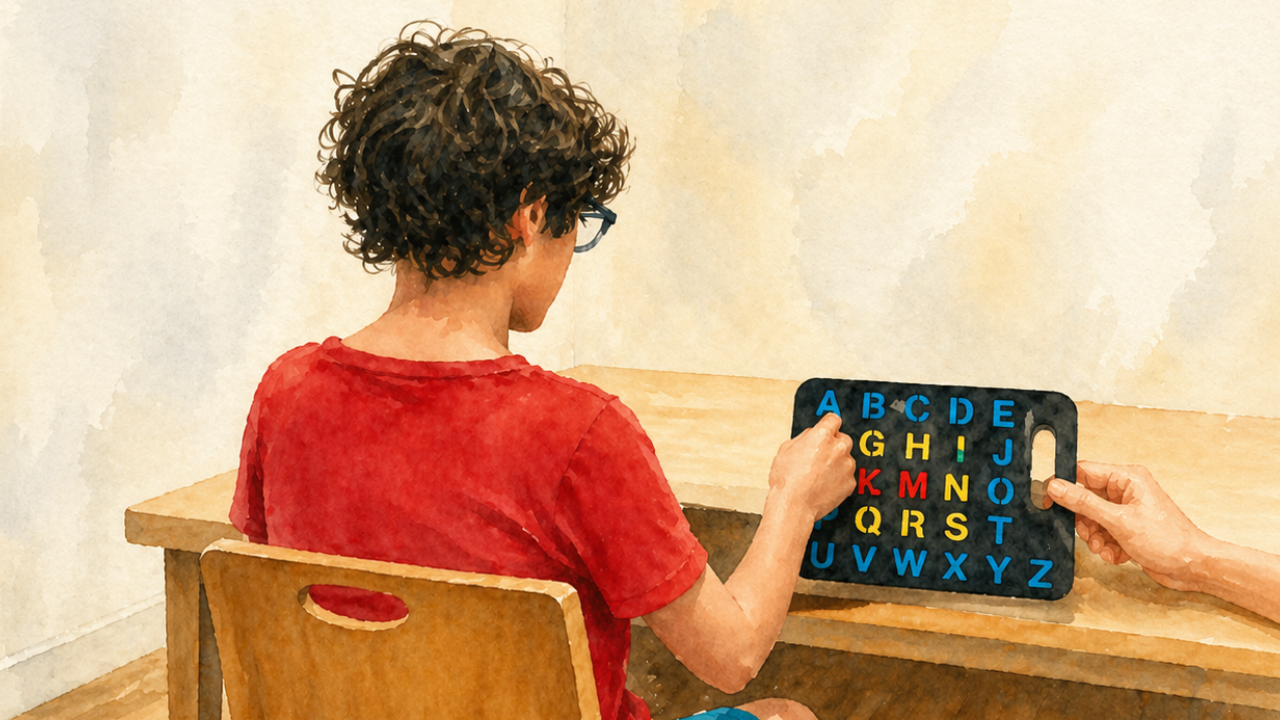
Not everything is independent, of course. Language arts, spelling, math, and family school are more supported. We use Dare to Homeschool Your Speller for language arts, spelling, Dare to Move, history and science. We utilize science and history family style - all four kids participate in the lessons, and Zeke does the spell lessons with me later. We've used a combination of Dare to Homeschool Your Speller, CTC math, and The Good and the Beautiful for math. Right now he's doing Level 6 TGTB math. We utilize the spell boards and a whiteboard to complete the lessons together.
I mentioned we do history and science as a family. We also do literature, geography, and art! We call this time of the day "family school". Family school gives us a way to include everyone in rich, age-appropriate content without making everything depend on worksheets or written output. We can read aloud, watch videos, look at maps, work through lessons, and create. With multiple kids, this is a time-saving method and its become our favorite time of the day!
Zeke’s Weekly Goals
Because the loop schedule is flexible, I still like having a weekly visual of what we are aiming for. It helps him see the bigger picture without making every single day rigid. We use a visual chart to help us keep track.
A typical weekly goal might look like this:
☐ Language Arts — 3 times
☐ Math — 3 times
☐ Typing — 3 times
☐ Audiobook — 3 times
☐ Spelling — 4 times
☐ On Your Own / Workout — 3 total between the two
☐ Family School — 3 times
The goal is not perfection. The goal is direction. If he hits most of these things over the course of a week, he has had a very full week. He has worked on academics, communication, movement, independence, listening, regulation, and participation in family learning.
So What Does a 12-Year-Old Speller Do All Day?
Let's break it down. The answer is not “school from 9 to 3.” It is more like:
☐ Movement (Dare to Move and NEX playground)
☐ Sensory input (Dare to Move, listening therapy, etc)
☐ Therapy, when scheduled (PT)
☐ A few meaningful academic subjects (language arts, spelling, math)
☐ Independent work
☐ Family learning
☐ Chores
☐ Breaks
☐ Preferred activities after work is done
That is a full day. It may not look like a traditional school day, but that is kind of the point. Homeschooling gives us room to build a day that actually works for his body and brain.
For a 12-year-old speller, a productive day at home does not have to mean sitting at a desk for six hours. It can mean moving through a rhythm of regulation, learning, independence, support, and rest. It can mean doing four solid school tasks instead of trying to cram in every subject every day. It can mean using audiobooks, videos, spelling, typing, movement, puzzles, and family time as real parts of education.
P.S. Dare to Move, Language Arts, and Math... created FOR spellers by a spellers mom... are all available right now in our Foundations membership for just $29/mo!